
Ideas for the play‑based Pre‑K classroom
From one Pre-K teacher to another: research-grounded ideas you can bring into your classroom and adapt for your students.
Browse by classroom corner
No posts in this corner yet. More are on the way!
Free goodies for your classroom
Why Students Avoid an Interest Area (and How to Fix It)
When students avoid an interest area, the problem is usually the area, not the children. Two quick checks tell you what to change: are students playing there, and can they play there on their own? If the answer to either one is no, you adjust the space or the materials, watch again, and keep adjusting.
From one Pre-K teacher to another: setting up your interest areas is a lot of work. It's tempting to finish, step back and think, "Done! They'll play, and I'll switch it out for the next study." But putting the area out is just the beginning. Now we get to see how that combination of materials, in that space, works with these students, their interests and their behaviors. You become a little researcher, a scientist, putting things together and then stepping back to ask, "Okay, what happened? How did that work out?"
Why do students avoid certain interest areas?
Everyone wants to play in blocks. Dramatic play is packed. And the library? Crickets. When one, two or three areas sit empty and you can't even convince one student to try them, it's not them, it's the area. Something about it isn't inviting or isn't accessible yet, and your job is to figure out what.
All of your interest areas should be inviting and engaging, not just the favorites. That's why I reflect on every area with the same two goals.
How do I know if an interest area is working?
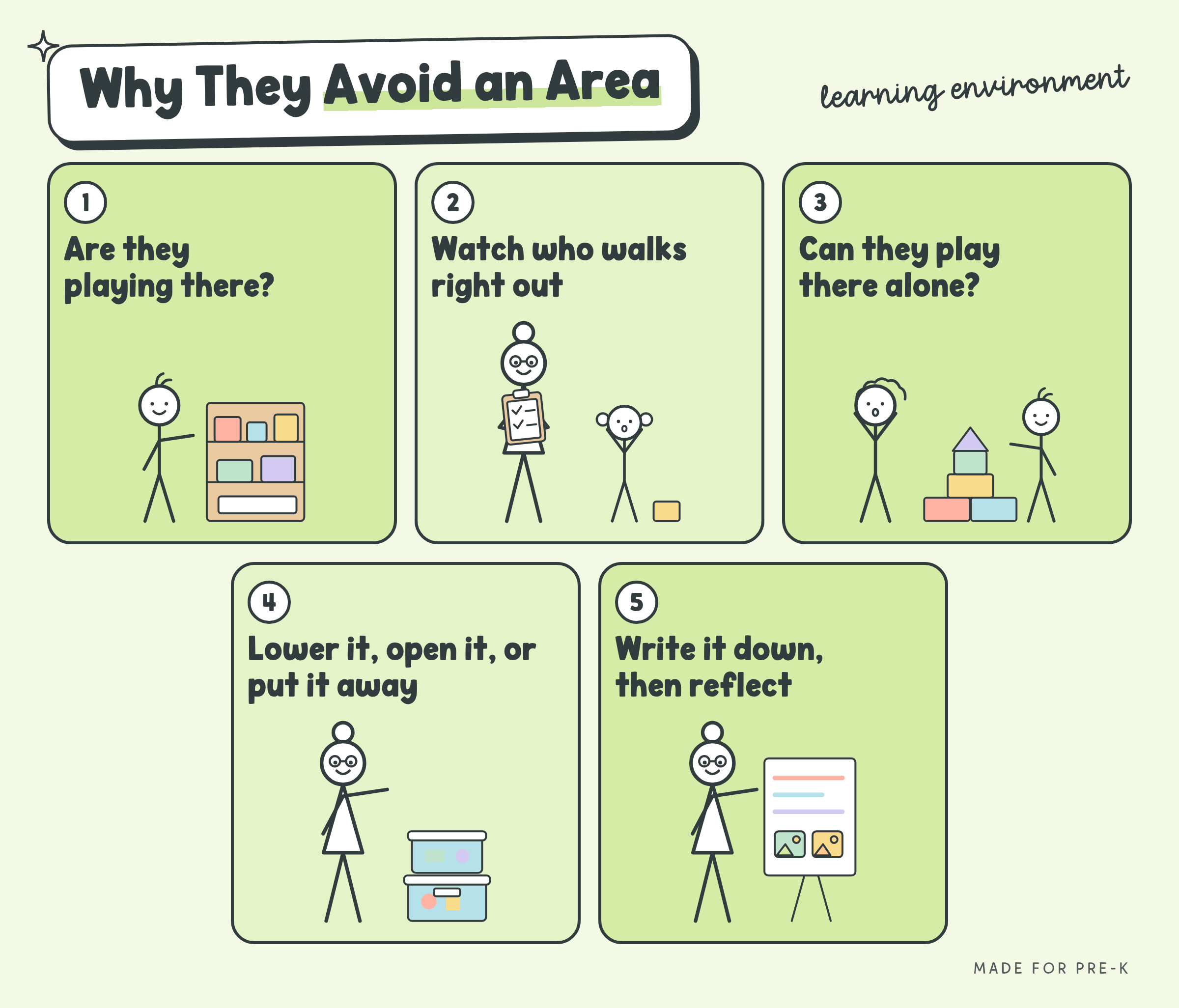
1. Check one: are students playing there?
If students aren't playing in an area, something needs to change to make it more inviting or more accessible. Start by figuring out why they're not playing there.
Try this: For a few days, jot down which areas children choose at choice time and which ones stay empty. A pattern shows up fast.
2. Watch the child who walks in and walks out
Maybe you notice a child go into an area and leave after a minute. That minute is information. Why did they leave? What was the difficulty, the challenge, the hurdle? What could you add or change so they'd want to stay?
Try this: The next time a child leaves an area quickly, look at what they touched last. Was it hard to open, hard to reach, or unclear what to do with it?
3. Check two: can they play there independently?
If students need your help to reach something, to open something, or for every step of an activity, they're not ready for it yet. That doesn't mean they've failed. It means the material and the child aren't a match right now.
Try this: Stand back during choice time and count how many times you're called to an area for help. The area that keeps calling you is the one to adjust.
4. Lower it, open it, or put it away
The fixes are usually small. Lower the thing they needed help reaching. Move the thing they couldn't open into an open container or basket. Or put the material away and set out something more accessible.
Try this: Pick one area this week and make one change only. Then watch for two or three days before you change anything else.
5. Write it down, then reflect and respond
When you're in the moment, you have all these ideas running through your head, times ten for every area. Why juggle all of that when you don't have to? I use a simple template for each area: my goals, what I noticed (students not going there, materials not being put away) and possible solutions.
Try this: Make a two-column page for each area: "What I noticed" and "What I'll try." Fill in one line a day.
These are the little dials that get moved every day. Invisibly, your classroom runs smoother and smoother because you're making intentional observations, reflecting on them and responding.
What if an area still isn't working?
Don't treat it as a failure. An interest area no one goes to is an opportunity. Keep the quote I open my workbook with in mind: "Play is the highest form of research." Your students are researching through play, and you're researching your room right alongside them. If you use The Creative Curriculum, Foundation Volume 2: Interest Areas walks through each area's objectives, materials, the teacher's role and how to reflect on what you set out. And if labels and visuals are part of the hurdle, my post on making your classroom walls teach has ideas like photo labels on every bin.
Go deeper
This reflection routine comes from Week 3 of The Jumpstart Challenge, my 5-week challenge for getting your classroom and routines ready step by step. Week 3 is all about the learning environment and labels, with the workbook templates I use to plan and reflect on every interest area. It's $49, and we do it together, one week at a time.
Start with one area this week. Check if they're playing there, check if they can do it alone, and move one dial.
Frequently asked questions
Why won't my preschoolers play in the library or art area? Usually something in the area isn't inviting or accessible yet. Watch what happens when a child walks in, then adjust one thing: what's out, where it sits, or how it's stored.
How often should I change my interest areas? Small adjustments can happen any day, based on what you observe. Bigger changes usually come with a new study.
What if students need my help in an area all the time? That's a sign the material isn't a match yet. Lower it, put it in an open basket, or put it away and offer something they can use on their own.
How many interest areas are in The Creative Curriculum? Ten indoor areas plus the outdoors: blocks, dramatic play, toys and games, art, library, discovery, sand and water, music and movement, cooking, technology, and outdoors.