Ideas for the play‑based Pre‑K classroom
From one Pre-K teacher to another: research-grounded ideas you can bring into your classroom and adapt for your students.
Browse by classroom corner
No posts in this corner yet. More are on the way!
Free goodies for your classroom
How to Teach Self-Regulation in Preschool: 6 Strategies
Self-regulation is a preschooler's growing ability to manage their feelings, attention and actions, so they can keep learning even when you're not right beside them. Children don't build it on their own. It grows through co-regulation with a calm, caring adult, predictable routines, real choices and lots of play. The six strategies below are how I help my students get there, and they're what make small groups run smoothly.
If you've ever tried to run a small group while three other students need you at the same time, you know the feeling of wishing you could multiply yourself. Here's what I want you to hear, teacher to teacher: the problem usually isn't that small groups don't work in your classroom. Your students need more explicit, playful practice with self-regulation, and you can give them that.
The research backs this up. Children with stronger self-regulation are better able to focus, stay engaged and learn alongside their peers (Blair & Raver, 2015).
What is self-regulation in preschool?
Self-regulation is how children manage big feelings, focus their attention and control their actions. In a Pre-K classroom, it looks like waiting for a turn at the sensory table, using words instead of hands when a block tower falls, or staying with a puzzle that's a little tricky.
It's closely tied to executive function: working memory, inhibitory control and flexible thinking (Diamond & Lee, 2011). These skills are still developing in 3- to 5-year-olds, so you'll see them come and go. A student who waits beautifully on Monday may fall apart on Friday. That's development, not defiance. Behavior is communication, and it tells us which skills a child is still building.
Why does self-regulation matter for small groups?
Small groups ask the rest of your class to work without you. While you're with four students at the table, the others need to choose an activity, stay with it, solve small problems and handle frustration on their own. Every one of those is a self-regulation skill.
When small group time feels chaotic, it's usually a sign that students need more practice with these skills, not that small groups are the wrong fit.
How do you teach self-regulation in preschool? 6 strategies
1. Co-regulate first through warm relationships
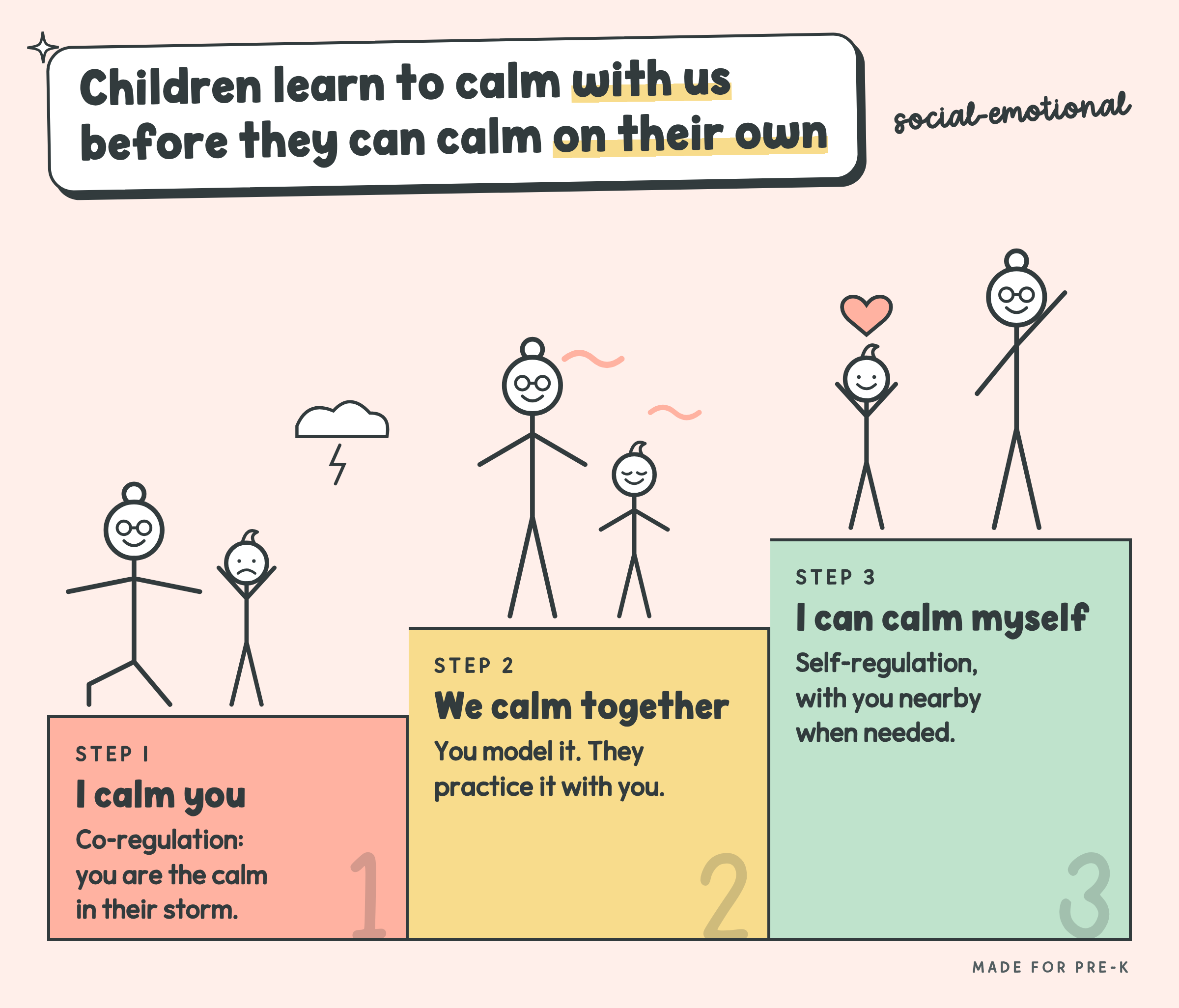
Children learn to calm themselves by being calmed by a trusted adult. This is called co-regulation, and it comes before self-regulation (Murray, Rosanbalm, Christopoulos & Hamoudi, 2015). Warm, close teacher-child relationships in the early years also predict how children do in school long after Pre-K (Hamre & Pianta, 2001).
Try this: Greet each student by name at the door. When a child is upset, get down to their level, lower your voice and name what you see: "Your body looks really frustrated. I'm right here."
2. Model self-regulation out loud
Children learn by watching and imitating the adults around them (Bandura, 1977). When you narrate your own regulation, you make an invisible skill visible.
Try this: When the paint spills, think out loud: "Oh no, I feel frustrated. I'm going to take a big breath, and then I'll get a towel."
3. Keep routines predictable and visual
Predictable routines help children feel safe and know what comes next, which leaves more energy for learning (Center on the Social and Emotional Foundations for Early Learning). A visual schedule, posted at the children's eye level, lets them check what's happening instead of asking you.
Try this: Walk through the visual schedule at morning meeting, and point to it again before each transition. When something changes, show the change on the schedule.
4. Teach calming strategies when students are calm
Deep breathing, counting and a cozy calm-down space are powerful tools. They work best when students practice them during calm moments, so the tools are ready when big feelings arrive.
Try this: Practice "smell the flower, blow out the candle" breathing during circle time. Introduce your calm-down space as a cozy place to feel better, never as a time-out.
5. Offer real choices
Choice builds independence and motivation. When children have some control over their learning, they're more engaged and more invested in it (Deci & Ryan, 2000).
Try this: Offer two or three choices you're happy with: which interest area to start in, which color clipboard to use, or which study to vote on next.
6. Make room for rich, planned play
Play is where self-regulation gets its best workout. In dramatic play, children hold a role, follow the rules of the pretend scenario and negotiate with friends, which is all self-regulation in action. A Pre-K program built around planned, mature make-believe play improved children's executive function skills (Diamond, Barnett, Thomas & Munro, 2007). Lucky for us, The Creative Curriculum is delivered through play.
Try this: Before choice time, ask each student to make a quick play plan: "Where will you play, and what will you do there?" Let them draw it or tell you. Then check in on the plan later.

How long does it take to build self-regulation?
These skills won't appear overnight, and you already know that. Like everything in Pre-K, they grow through repetition, exposure and practice over weeks and months. Expect some backsliding after breaks, schedule changes and big life events. That's normal. Keep returning to the same routines and strategies, and you'll see small groups get calmer over time.

Go deeper: Beyond Their Behavior
If behavior feels like the biggest barrier in your classroom right now, my workshop Beyond Their Behavior goes further. It helps you understand what children's behavior is communicating, and how to respond with co-regulation and connection.
Frequently asked questions
What is an example of self-regulation in preschool? A student who feels frustrated when a friend takes the blue marker, takes a breath and says, "Can I have it when you're done?" is showing self-regulation.
At what age do children develop self-regulation? Self-regulation grows quickly between ages 3 and 5, and it keeps developing through adolescence and into young adulthood (Murray et al., 2015). Expect Pre-K students to need lots of adult support.
What is the difference between self-regulation and co-regulation? Co-regulation is when a caring adult helps a child calm down and organize their feelings. Self-regulation is when the child can do it on their own. Co-regulation comes first and builds self-regulation.
Is a calm-down corner the same as a time-out? No. A time-out removes a child as a consequence. A calm-down space is a cozy place a child can choose, with tools that help them feel better and return to play.
How do I help students work independently during small groups? Start with short small group times, teach and practice the independent choices first, keep a predictable routine, and use play plans so students know what they'll do while you're at the table.
References
Bandura, A. (1977). Social learning theory. Prentice Hall.
Blair, C., & Raver, C. C. (2015). School readiness and self-regulation: A developmental psychobiological approach. Annual Review of Psychology, 66, 711–731.
Center on the Social and Emotional Foundations for Early Learning. Helping children understand routines and classroom schedules (What Works Brief #3). Vanderbilt University.
Deci, E. L., & Ryan, R. M. (2000). The "what" and "why" of goal pursuits: Human needs and the self-determination of behavior. Psychological Inquiry, 11(4), 227–268.
Diamond, A., Barnett, W. S., Thomas, J., & Munro, S. (2007). Preschool program improves cognitive control. Science, 318(5855), 1387–1388.
Diamond, A., & Lee, K. (2011). Interventions shown to aid executive function development in children 4 to 12 years old. Science, 333(6045), 959–964.
Hamre, B. K., & Pianta, R. C. (2001). Early teacher–child relationships and the trajectory of children's school outcomes through eighth grade. Child Development, 72(2), 625–638.
Murray, D. W., Rosanbalm, K., Christopoulos, C., & Hamoudi, A. (2015). Self-regulation and toxic stress: Foundations for understanding self-regulation from an applied developmental perspective (OPRE Report #2015-21). Administration for Children and Families.