Ideas for the play‑based Pre‑K classroom
From one Pre-K teacher to another: research-grounded ideas you can bring into your classroom and adapt for your students.
Browse by classroom corner
No posts in this corner yet. More are on the way!
Free goodies for your classroom
Beyond "I'm Sorry": How to Teach Preschoolers to Make Things Right
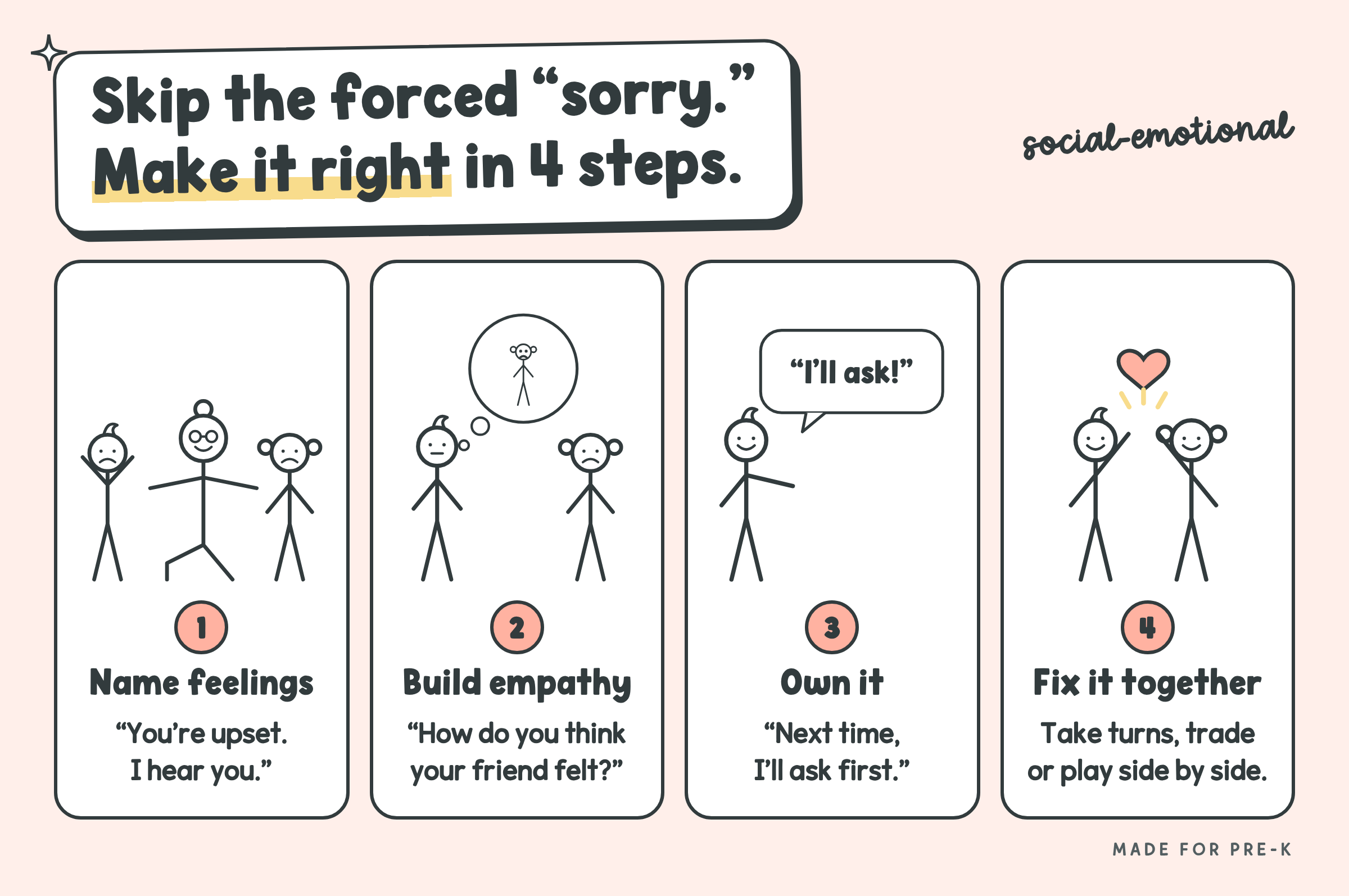
When preschoolers have a conflict, a quick "say you're sorry" rarely repairs anything. A better approach is a short reconciliation conversation in four steps: acknowledge both children's feelings, build empathy, help the child take responsibility, and solve the problem together. It takes a little longer, and it teaches the skills children actually need to repair a friendship.
As Pre-K teachers, one of our most important jobs is helping students build social-emotional skills: managing big emotions, communicating and building positive relationships. Making things right after a conflict is a big part of that.
Why doesn't a forced "I'm sorry" work?
We've all seen it. Two students grab for the same truck, and we say, "Say you're sorry." One child mumbles the words, and both go back to playing, or not. The apology ends the moment, but it doesn't teach much.
A forced apology can become a script children use to get out of trouble, without understanding how the other child feels or what to do differently next time. What children need is practice with the skills underneath a real apology: noticing feelings, seeing another point of view, owning their part and fixing the problem.
How do you teach preschoolers to make things right? 4 steps
1. Acknowledge both children's feelings
Start by helping each child name how they feel, and validate those feelings. Both children have feelings in a conflict, not only the one who was hurt.
Try this: "You're feeling frustrated because your friend took the truck without asking. I hear you."
2. Build empathy
Once each child has been heard, help them think about the other child's feelings.
Try this: "How do you think your friend felt when the truck was taken?" Give them time to answer, and help with feeling words if they need them.

3. Help the child take responsibility
Instead of jumping to "sorry," help the child notice what happened and what they could do differently. Many preschoolers need a sentence starter to get there.
Try this: "It sounds like you took the truck without asking. What could you do next time?" Then offer a starter: "Next time, I'm going to ask first so everyone can have a turn."
4. Solve the problem together
Finally, help the children find a solution that works for both of them: taking turns, finding another truck to play with together or making a plan they both agree on. In my classroom, we use a wheel of choices so students have a visual reminder of strategies they can try.
Try this: Keep a small set of solution pictures (take turns, trade, play together, ask a teacher) where students can point to one in the moment.

Will this take longer than "say sorry"?
At first, yes. Each conversation takes a few minutes, and you'll do most of the talking in the beginning. Over the year, students start using the words on their own. That's when you'll hear a child say, "Can I have it when you're done?" without you in the middle. That's the payoff.
Go deeper: Beyond Their Behavior
Conflicts are communication. If you'd like more support understanding what students' behavior is telling you, and how to respond with connection, my workshop Beyond Their Behavior goes further. Learn more about Beyond Their Behavior
Frequently asked questions
Should preschoolers be made to say sorry?
A forced apology ends the moment but teaches little. It's more effective to guide a short conversation about feelings and solutions. A sincere "sorry" often comes naturally once the child understands how their friend feels.
What can a preschooler say instead of "sorry"?
Give them simple scripts: "Are you okay?", "Next time I'll ask first" or "Do you want to play together?"
How do I teach conflict resolution in preschool?
Name feelings, build empathy, help children take responsibility and solve the problem together. Visual supports like a wheel of choices help students remember their options.
At what age can children resolve conflicts on their own?
Preschoolers are just beginning. Expect to guide most conflicts with lots of adult support, and look for small signs of independence as the year goes on.