Ideas for the play‑based Pre‑K classroom
From one Pre-K teacher to another: research-grounded ideas you can bring into your classroom and adapt for your students.
Browse by classroom corner
No posts in this corner yet. More are on the way!
Free goodies for your classroom
9 Types of Documentation for Teaching Strategies GOLD
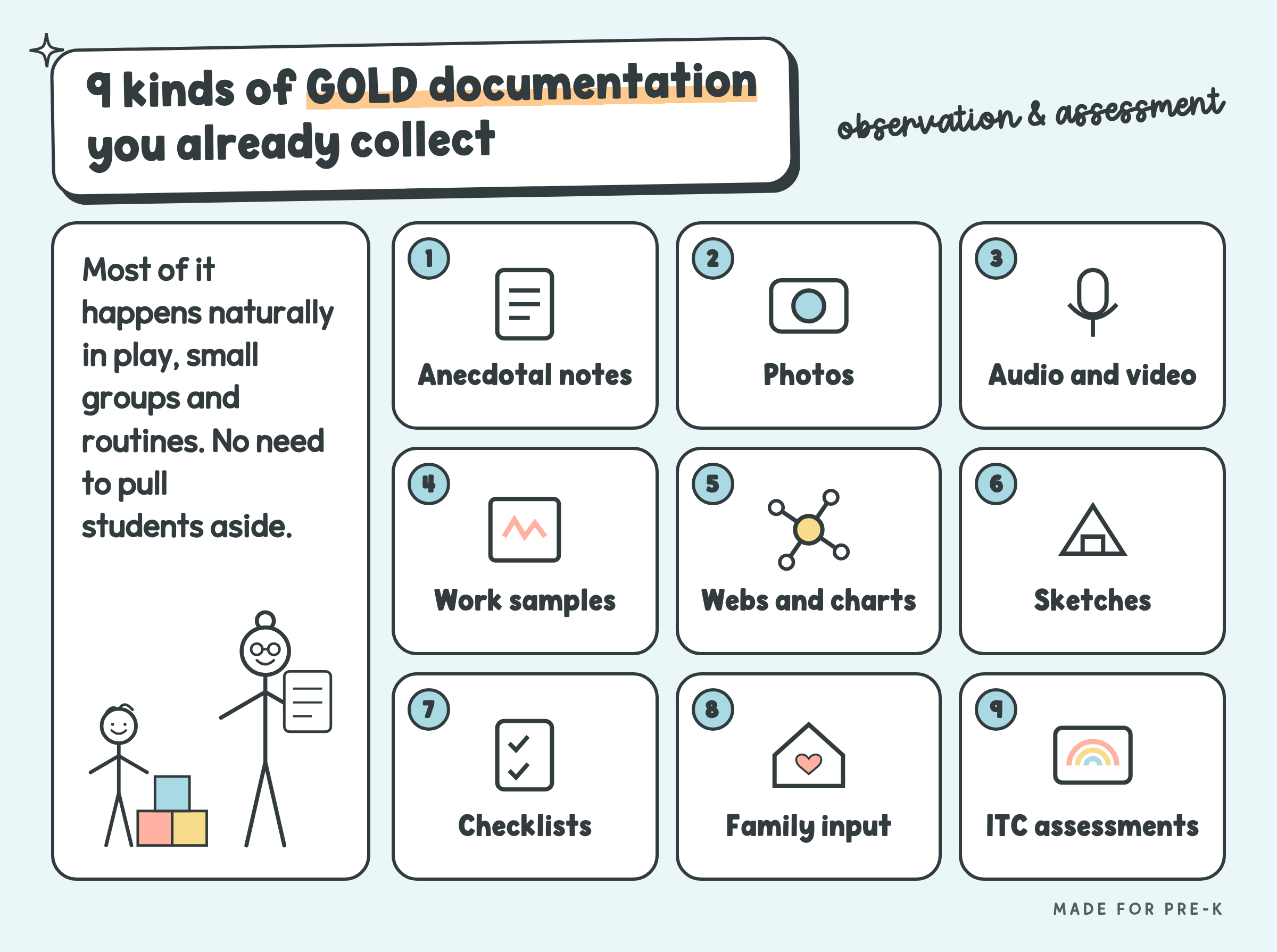
Teaching Strategies GOLD documentation can come from nine everyday sources: anecdotal notes, photographs, audio and video recordings, samples of children's work, your study webs, sketches of children's creations, checklists, input from families and staff, and Intentional Teaching Card assessments. If you follow the Teaching Guide, most of it happens naturally during your day, with no need to pull students aside.
We know ongoing assessment is the basis of effective teaching. But what does that actually mean? What counts as documentation for GOLD? When do you collect it? Which system works best? So. Many. Questions.
The good news: GOLD is aligned to The Creative Curriculum. If you follow the Teaching Guide and use the daily resources, you should cover your observations for each checkpoint period.
What counts as documentation for Teaching Strategies GOLD?
1. Anecdotal notes
Whenever you observe a student, jot down what you saw and heard. Take notes during the observation or right after, and add details later when you have time to reflect.
2. Photographs
Photograph children's work, process and play with a phone or tablet, and upload it to their portfolio. MyTeachingStrategies has an app, MyTS, but it's been glitchy in my experience, so I upload through the browser instead.
3. Audio and video recordings
A favorite shortcut: speak your observation instead of writing it. Your phone turns your voice into text, and you can upload it directly. Videos are great for capturing interactions.
4. Samples of children's work
This is one of the easiest and most effective ways to collect data. One of my favorites is name-writing. I see the growth every year, and I never get tired of it.

5. Your study webs and anchor charts
Throughout a study you'll make webs and anchor charts with your students. They often include students' dictations, questions and ideas, so snap a photo and upload it.
6. Sketches of children's creations
If a student draws a plan for the house they built in the Block area, that's important data. Save any sketches students make of their 3D creations.
7. Checklists
On-the-spot recording tools help you quickly capture certain physical, literacy and math skills. They're simple enough that teacher assistants can use them throughout the day too.

8. Input from families and staff
Any communication with families, formal or informal, can become GOLD documentation. Encourage families to download the TS Family app to share observations from home.
9. Intentional Teaching Card assessments
This one is streamlined and simple. In MyTeachingStrategies, go to the Teach tab and click the Intentional Teaching Card on your lesson plan (it has a rainbow next to it). Inside the card, click Assess to assign preliminary levels based on your observations. Those levels go in automatically as observation notes and show up when you finalize checkpoints.
Do I need to use all nine?
No. You may not use all of them, and that's okay. Knowing all nine means you're always ready, whether you have a pencil and paper, only your phone, or a great work sample in hand. We're teachers. We prepare for everything, and GOLD is no different.
Go deeper: the Pre-K Assessment Data Binder
Want one place to keep it all organized? My Pre-K Assessment Data Binder helps you track your observations and data through the year, so checkpoint time feels calm instead of rushed.
Frequently asked questions
How often should I collect GOLD documentation?
A little every day. When documentation is built into your routines, checkpoint time is much less stressful.
Do I need to pull students aside to assess them?
Usually not. If you follow the Teaching Guide, most observations happen naturally during Choice Time, small groups and daily routines.
What is the easiest type of GOLD documentation?
Work samples and photos are quick, and Intentional Teaching Card assessments go straight into your observation notes.
Can families contribute to GOLD documentation?
Yes. Family input counts, and the TS Family app makes it easy for families to share.