
Ideas for the play‑based Pre‑K classroom
From one Pre-K teacher to another: research-grounded ideas you can bring into your classroom and adapt for your students.
Browse by classroom corner
No posts in this corner yet. More are on the way!
Free goodies for your classroom
How to Make Real-World Math Concrete for Preschoolers
Time, money and place value are hard for young children because they're abstract: you can't hold an hour or see a "ten." The way to teach them is to make them concrete, with tools children can wear, hold, sort and play with, so the idea lives in their hands before it lives on paper.
Some links in this post are affiliate links, which means I earn a small commission at no extra cost to you. I only share materials I use with children.
To an adult, time, money and place value are just numbers. To a 4-year-old, they're completely abstract. As a Pre-K teacher, the question I always asked was: how do I make this concrete? How do I put it in their hands?
That question is why I'm using Lovevery's Math Skill Set, Part 2: Real-World Math in our homeschool right now, and why I would have loved it for small groups in my preschool classroom.
Why is real-world math hard for preschoolers?
Young children think in concrete terms. They understand what they can see, touch and move. Ideas like "a quarter past three" or "the 2 in 25 means two tens" don't have anything to grab onto yet. When we jump straight to worksheets or memorizing, children can repeat the words without understanding what they mean.
The fix isn't more practice on paper. It's giving children real objects and real reasons to use them, so the math makes sense before we ask them to write it down.
4 ways to make real-world math concrete
1. Make time something they can see
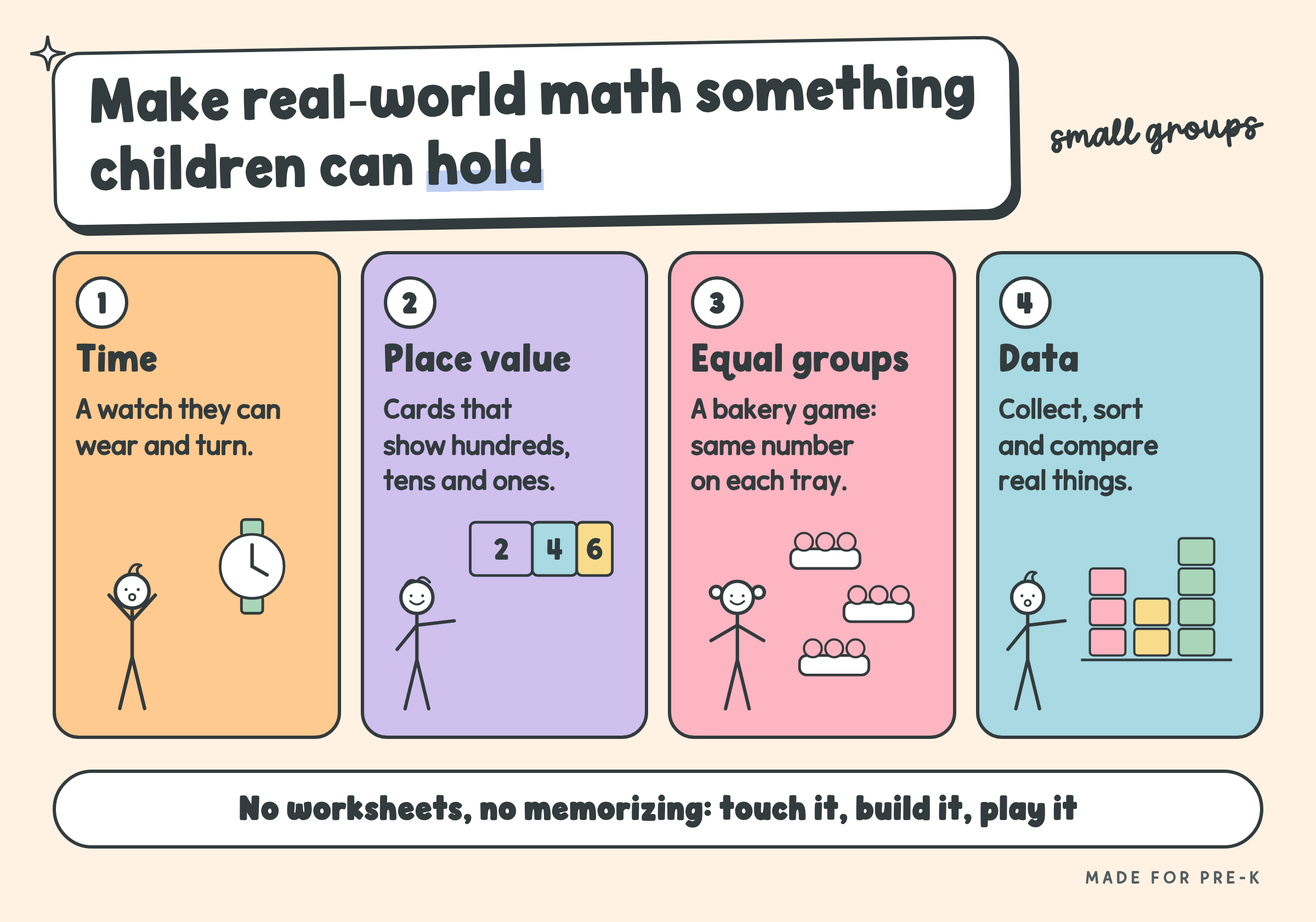
Clocks are tricky because time is invisible. A real analog watch changes that: children can wear it, turn the hands and read it during the day.
Try this: Connect the clock to your routine. "When the big hand is on the 6, we'll go outside." Let your students check the watch themselves.
In Real-World Math, this is a child-sized watch they can wear and turn, paired with books and games that use it.
2. Make place value something they can hold
"Hundreds, tens and ones" is a lot of vocabulary for a young child. Number cards that physically show hundreds, tens and ones let children build a number and see what each digit is worth.
Try this: Build numbers that matter to your students, like their age, their house number or how many days you've been in school, and talk about how many tens and ones are inside.
3. Turn multiplication into making equal groups
Multiplication sounds advanced, but at its heart it's just making equal groups, and children do that in play all the time. A bakery game where they fill trays with the same number of treats makes that idea playful and visual.
Try this: In your dramatic play bakery, ask, "Can you put 3 cupcakes on each plate for our 4 friends? How many is that altogether?"
4. Collect and compare real information
Data is everywhere in a Pre-K classroom: who's here today, favorite snacks, the weather. Collecting, sorting and comparing real information turns graphs into something children care about.
Try this: Make a quick class graph with sticky notes, "Which fruit do you like best?", and ask, "Which has the most? How do you know?"
What's in Lovevery's Real-World Math set?
Real-World Math is Part 2 of Lovevery's Math Skill Set, and it's now shipping. Lovevery describes it as covering kindergarten and 1st-grade skills: making equal groups (the foundation for multiplication and division), place value with multi-digit numbers, telling time, smart money habits, and collecting and interpreting data.
What I love is how it all connects. The books reinforce the tools, the tools lead into the games, and it becomes a little ecosystem of learning that's inviting and engaging. There are no worksheets and no memorizing. Children learn math by touching, building and playing, the way young children actually learn, and the set was designed with math education experts.
If your child or students are just starting with counting, patterns and early addition, Part 1, Hands-On Math, is the place to begin. Part 2 builds on it, and Part 3, Problem Solving with Math, is coming in 2027 with fractions and real-world problem solving.
Can I use this in a preschool classroom?
Yes. It's designed for families at home, but the games are a natural fit for a small group of three or four children. I would have used the watch during transitions, the bakery game in dramatic play, and the data game during small groups. Every idea in this post also works with materials you already have, so you can start today either way.
Looking for more ways to plan math into your day? Read Why Small Groups Matter in Pre-K (and What to Do in Them).
Go deeper: Real-World Math
If you want everything ready to go, with the watch, the place value cards, the bakery and data games and the books that tie them together, take a look at Lovevery's Math Skill Set. And for free play-based planning help, grab my free Pre-K lesson plan templates.
Frequently asked questions
At what age can children start learning about time and money? Preschoolers can start with the ideas behind them, like before and after, first and next, and trading coins in pretend play. Reading a clock and counting money usually come in kindergarten and 1st grade.
How do you teach place value to young children? Start with real objects children can group into tens, like linking cubes or straws in bundles, then connect those groups to number cards. Seeing and holding the tens comes before writing them.
Is multiplication too advanced for preschool? The formal skill is, but the idea isn't. Making equal groups in play, like the same number of cookies on each plate, builds the understanding children will use later.
Do I need Part 1 before Part 2? Lovevery describes Part 1 as Pre-K and kindergarten skills and Part 2 as kindergarten and 1st-grade skills, so most younger children start with Part 1. You can buy each part on its own or both together.