Ideas for the play‑based Pre‑K classroom
From one Pre-K teacher to another: research-grounded ideas you can bring into your classroom and adapt for your students.
Browse by classroom corner
No posts in this corner yet. More are on the way!
Free goodies for your classroom
Why Small Groups Matter in Pre-K (and What to Do in Them)
Small groups are a short block, about 15–20 minutes, where you work with a few students on an activity you've planned. They're worth protecting every day because they let you see exactly how each child is thinking, meet them where they are and help them reach the next step. That's very hard to do with the whole class at once.
If you're still getting familiar with The Creative Curriculum, some days may feel like building the plane while flying it. Hang in there. It does get better. And even on days when it feels impossible to fit everything in, there's one part of our day we never skip: small groups.
What are small groups in The Creative Curriculum?
The Creative Curriculum daily schedule includes a block for small groups: about 15–20 minutes when students work in groups on an activity you've chosen. There's a lot of flexibility in how you run them. That's freeing, and it can also feel tricky when you're still learning a new curriculum and want more structure.
Why are small groups too important to skip?
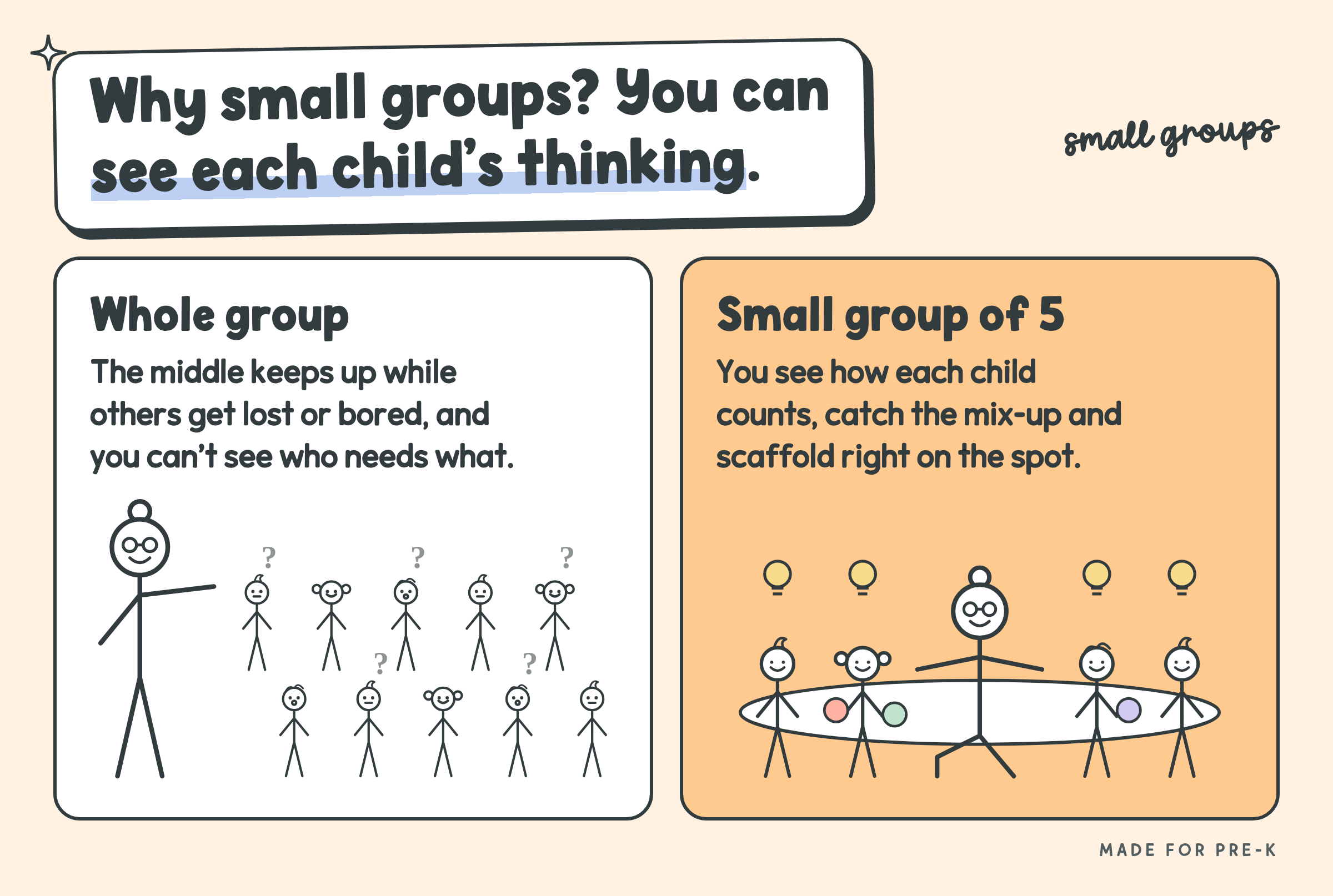
Imagine teaching your whole class to count up to 10 objects with manipulatives. You might lose the students who can't count yet and the ones who can already count to 100. Even the students in the middle may just go through the motions, and you won't get accurate information about what each one can do.
Now imagine teaching that same lesson to five students who are all learning to count objects. You can watch how each one counts and notice their errors. Are they struggling with one-to-one correspondence, or with knowing that the last number tells how many? You can offer support on the spot and scaffold them to the next level. Those details are easy to miss in a whole group.
Small groups also help in other ways:
They make differentiation possible. You can focus on each child's strengths and needs and help them move to their next level in Teaching Strategies GOLD.
They build social skills. Students practice cooperating, respecting each other's ideas and working together while they investigate.
They give you better observations. What you notice in a small group becomes rich documentation.
What can you do during small groups? 6 ideas
Intentional Teaching Cards aligned to GOLD, like math, literacy and physical development
Project work, from anchor charts to investigations in your study
Introducing new materials or interest areas, including re-teaching expectations
Goal-focused practice, like fine motor journals or cutting with scissors
Independent materials students will use on their own later, like blocks, playdough or building toys
Anything that fits your students. Get creative!

How do I start if I'm not doing small groups yet?
It's all good. Noticing where you have room to grow is the first step. Start small: one or two groups a day, a predictable routine and short sessions while your students build stamina. If you're committed to being more intentional with small groups, you'll see the gains in your students' growth and development.
While you're at the table, the rest of your class needs to work on their own, and that takes self-regulation. My post How to Teach Self-Regulation in Preschool shares six strategies to help.

Go deeper: The Curriculum Corner
Want step-by-step support running small groups with The Creative Curriculum, from Intentional Teaching Cards to grouping your students? My course The Curriculum Corner walks you through it.
Frequently asked questions
How long should small groups be in Pre-K?
About 15–20 minutes. Early in the year, start shorter and build up as students gain stamina.
How many students should be in a small group?
I like four groups of five students. Smaller groups give you a closer look at each child.
How do you group students for small groups?
Group by what you're teaching: by skill level for targeted practice, or by language for bilingual students. Mixed groups work well for projects and investigations.
What do the other students do during small groups?
They work in interest areas or with independent materials they already know how to use. Teaching those routines first makes small groups run smoothly.