Ideas for the play‑based Pre‑K classroom
From one Pre-K teacher to another: research-grounded ideas you can bring into your classroom and adapt for your students.
Browse by classroom corner
No posts in this corner yet. More are on the way!
Free goodies for your classroom
The Art of Inquiry: Fostering Curiosity in Pre-K with Visuals
The art of inquiry is how we help preschoolers turn their natural curiosity into real questions they can ask, explore and answer together. Intentional visuals, like real photos, story pictures and props, give children something concrete to wonder about, so the "How?", "Why?" and "What if?" questions start coming from them instead of from us.
In the heart of every child is a natural explorer, a budding scientist or a curious historian, all yearning to understand the world. So how do we ignite that curiosity in our Pre-K classrooms? For me, the answer lies in the art of inquiry, nurtured by the strategic use of intentional visuals. This approach is rooted in project-based learning and the Reggio Emilia philosophy, and it trusts children to lead their learning through questions and exploration.
What is inquiry-based learning in preschool?
Inquiry-based learning means children's questions drive the learning. Instead of the teacher delivering facts for students to absorb, children notice something, wonder about it, ask a question and investigate it with you. In a play-based Pre-K classroom, it looks like a group of students asking why the caterpillar stopped eating, then watching, drawing and talking about it for days.
Why don't preschoolers ask questions on their own?
Children are naturally curious, but the skill of forming and saying a meaningful question doesn't come on its own. It has to be cultivated. Traditional, teacher-led settings often lean toward passive learning, where children are expected to absorb information rather than engage with it. That can quiet curiosity and make the jump to active inquiry feel hard for young learners and for us as teachers.
How do visuals spark questions in Pre-K?
Visuals are so much more than decoration. They are tools that invite children to wonder, ask and think. A classroom rich in thoughtfully chosen visuals can turn passive observers into active participants.
A photo of a caterpillar on a leaf, different sources of water or buildings from around the world can prompt "How?", "Why?" and "What if?" questions. Visuals are especially helpful for multilingual learners and for students who are still developing their language skills, which is most of our preschoolers.

3 ways to encourage inquiry with visuals
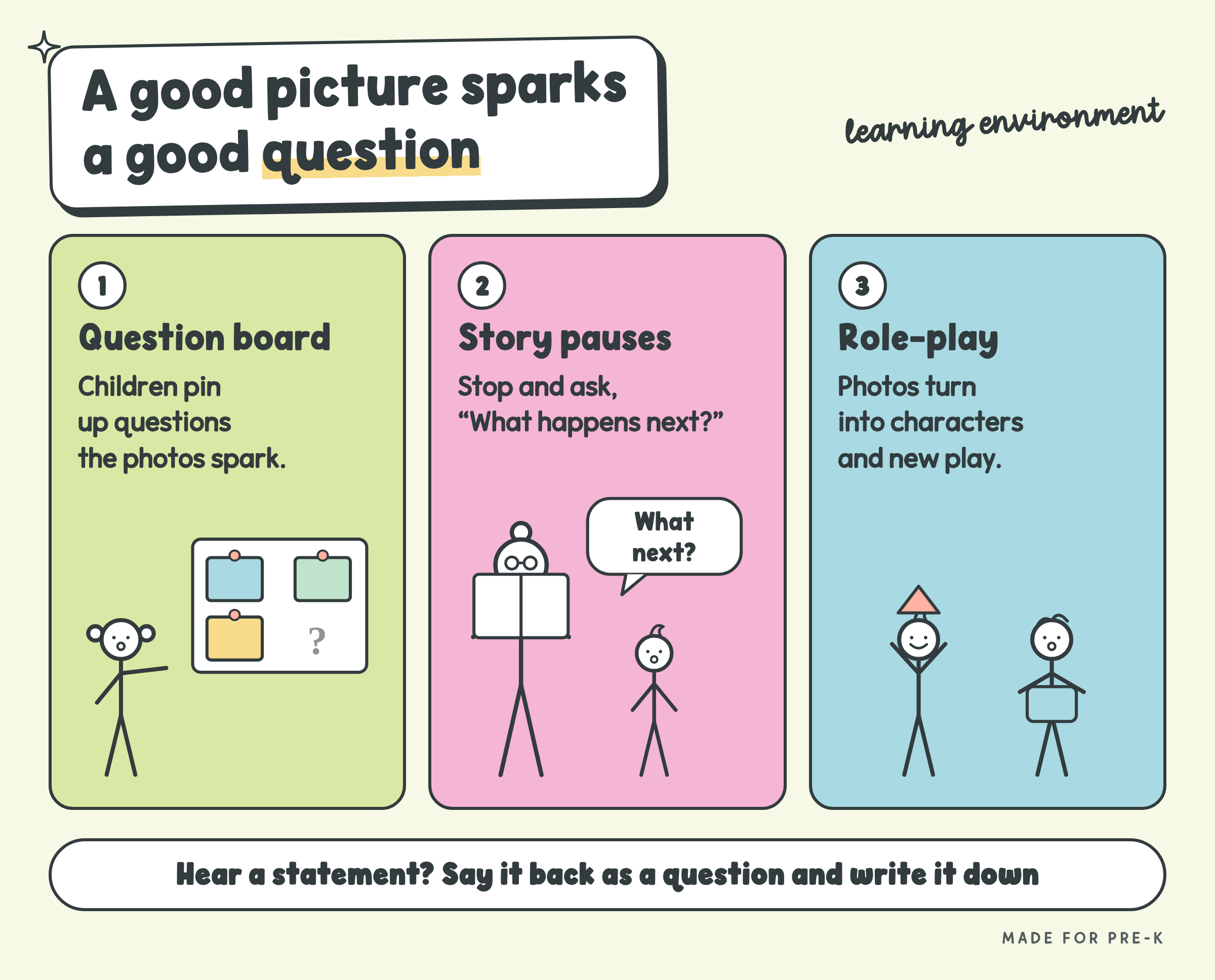
1. Create a question board
Set up an interactive space where children can pin up the questions that come from your classroom visuals and studies. Over time, the board becomes a shared investigation that builds a community of inquiry and collaboration.
Try this: Post one striking real photo next to the board each week. When a student wonders out loud, write their question on a sticky note with their name and add it to the board together.
2. Pause your read-alouds for story prompts
Choose visuals that connect to the story or study you're exploring. Strategic pauses with questions like "What do you think happens next?" encourage children to use picture clues to predict, which deepens their engagement with the story.
Try this: Before you turn the page, cover part of the picture and ask, "What do you notice? What might be hiding here?"
3. Use visuals for role-play
Visual cues can launch role-play, letting children become characters from a story or try out a new dramatic play setup. Acting it out builds comprehension and empathy and gives children a whole-body way to understand an idea.
Try this: Add photos of real workers or places from your current study to the dramatic play area and watch the questions and new play that follow.
How do I help a child who answers with statements instead of questions?
Patience is key. Building a classroom where inquiry thrives is a gradual process, and each child's path to asking questions is unique. Some will take longer to ask questions, and others will respond with statements at first. That's development, and our job is to keep supporting it with lots of chances to practice.
Sometimes that means restating a child's statement as a question, having them repeat it, then writing it down and reading it back to the class. "The bug is fast" becomes "Why is the bug so fast?" and suddenly the whole group is wondering with them.
If you're looking for more ways to choose topics your students will be curious about, read How to Choose a Study Topic Your Preschoolers Will Love.
The journey ahead
Weaving visuals into our curriculum and daily routines does more than make the room look nice. It enriches the thinking and the emotional life of the classroom. Our role is to guide children as they follow their curiosity, so every question becomes the start of a new adventure in understanding and every child gets to be an explorer.
Go deeper: The Ultimate Real Photo Bundle
If you want real photos ready to spark questions in every study, The Ultimate Real Photo Bundle gives you high-quality images for discussion, vocabulary and shared writing, so you can spend less time searching and more time wondering with your students.
Frequently asked questions
What is an example of inquiry in preschool? A student notices that the ice in the sensory bin is shrinking and asks, "Where did the ice go?" The class predicts, watches the ice over the morning and talks about what they saw.
Why are real photos better than clip art for inquiry? Real photos show details children can notice and wonder about, like textures, sizes and settings. Those details lead to richer questions and more accurate vocabulary.
How long does it take preschoolers to start asking questions? It varies. Many children start with statements, and with steady modeling and restating, questions usually grow over weeks and months, not days.
Is inquiry-based learning the same as the Reggio Emilia approach? Not exactly. Reggio Emilia is a whole philosophy of early education, and inquiry is one of its core ideas. You can bring inquiry into any play-based Pre-K classroom, including one that uses The Creative Curriculum.