Ideas for the play‑based Pre‑K classroom
From one Pre-K teacher to another: research-grounded ideas you can bring into your classroom and adapt for your students.
Browse by classroom corner
No posts in this corner yet. More are on the way!
Free goodies for your classroom
What Is That Behavior Telling You? ABC Observation for Pre-K
An ABC observation is a simple way to figure out what a challenging behavior is telling you. You write down the Antecedent (what happened right before), the Behavior (exactly what the child did), and the Consequence (what happened right after). After a few entries, patterns show up, and you can respond to the need instead of only the behavior.
We've all had that student. The one whose name we say fifty times a day, and we go home wondering, "Why does this keep happening?" I've been there more times than I can count. What finally changed things for me wasn't a new reward chart. It was slowing down to watch, write and look for the pattern.
What does "behavior is communication" mean?
Young children can't always tell us, "I'm overwhelmed," "I need a break," or "I don't know how to join that game." So they show us. Hitting, running, hiding under the table or yelling "No!" are often a child's way of saying something they don't have the words or skills for yet. When we treat behavior as a message, our job shifts from stopping it to understanding it.
What is an ABC observation?
It's a short note you write each time a behavior happens, in three parts:
A: Antecedent | B: Behavior | C: Consequence |
|---|---|---|
What happened right before? Where, when, who was nearby, what was asked? | What did the child do, exactly? Write what you saw and heard, not a label. | What happened right after? What did adults and peers do? What did the child get or avoid? |
Cleanup was announced during blocks. | Threw a block and ran to the cubbies. | Teacher walked over; child missed cleanup. |
That last column matters. In the example, the child may be learning that throwing a block gets them out of cleanup. That's information, not a judgment.
How do I do an ABC observation in a busy Pre-K classroom?
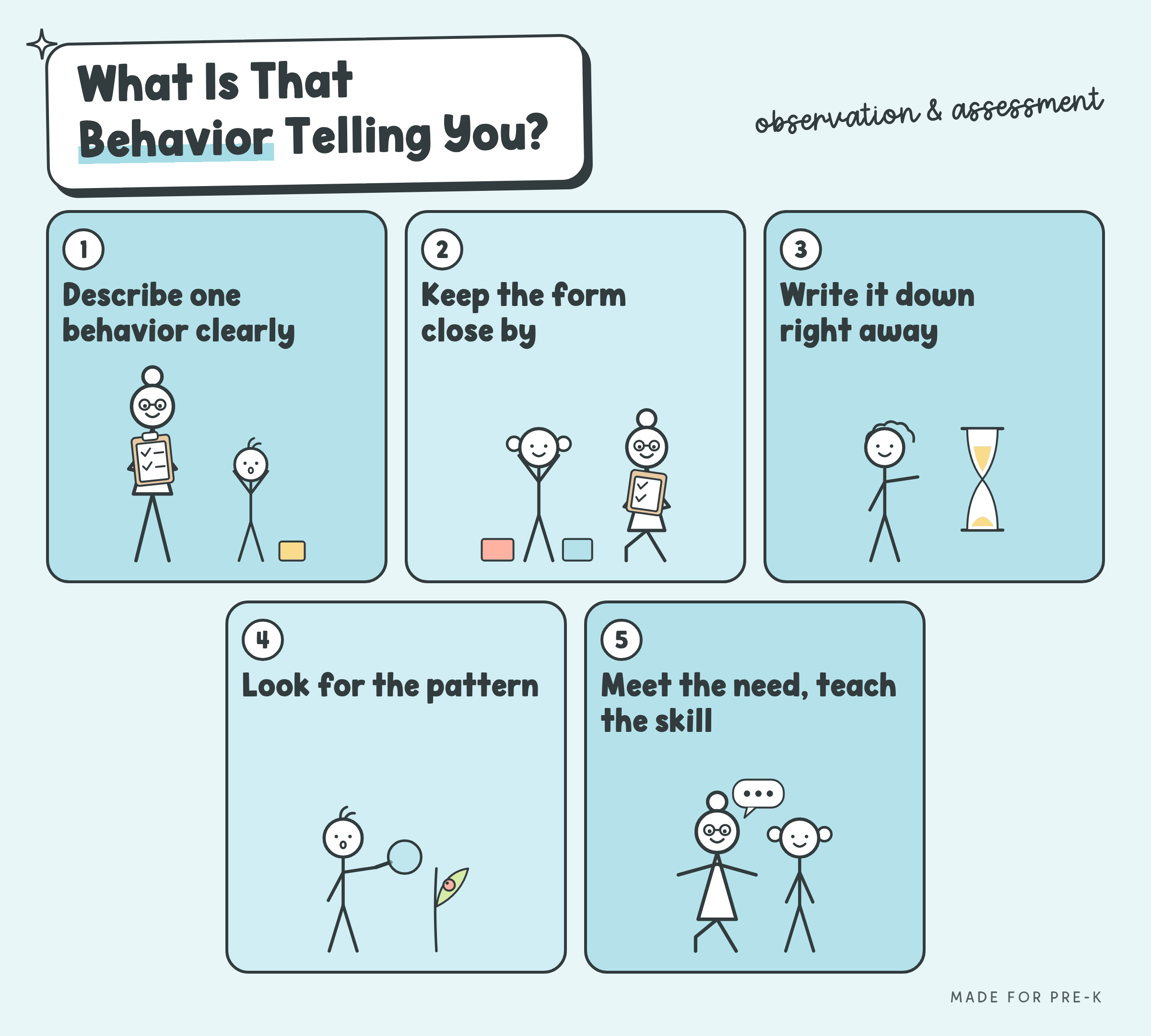
1. Pick one behavior and describe it clearly
"Being defiant" is hard to observe. "Throws materials when asked to clean up" is easy. A clear description helps you and your co-teacher write down the same thing.
Try this: Write the behavior the way a video camera would see it.
2. Keep the form where the behavior happens
A clipboard by the block area or a few sticky notes in your pocket will get used. A form in a drawer won't.
Try this: Make a simple three-column sheet and keep it on a clipboard in the area where the behavior happens most.
3. Write it down within a few minutes
You don't need full sentences. Time, place, a few words per column. Ask your co-teacher to jot notes too.
Try this: Collect 5–10 entries over one to two weeks before deciding what's going on.
4. Look for the pattern
Read your notes and ask: Does it happen at the same time of day? During transitions? When a certain demand is made? With the same peers? What does the child usually get or avoid afterward? The pattern points to the need: help with transitions, a way to ask for a break, words to join play, or more connection.
Try this: Highlight every antecedent that repeats. That's usually where your support plan starts.
5. Respond to the need, then teach the skill
Once you know the message, change what you can before the behavior (a transition warning, a visual, a job during cleanup) and teach the child another way to get the same need met. This is where co-regulation comes in. Researchers Rosanbalm and Murray describe co-regulation as the supportive process between caring adults and children that builds self-regulation. They name three parts: a warm, responsive relationship, an environment structured to make self-regulation manageable, and teaching and coaching skills.
Try this: For the cleanup example, give a 2-minute warning, hand the child a "cleanup captain" job, and practice the words "I need help" together.
For the next step after the pattern, my post on how to teach self-regulation in preschool has six strategies you can use right away.
Go deeper
If you want to get better at reading the message behind behavior and responding with calm, connected support, my Beyond Their Behavior workshop is made for that. It's $11 and focused on seeing behavior as communication and using co-regulation in your classroom.
When we stop asking "How do I make this stop?" and start asking "What is this child telling me?", everything changes for the child and for us.
Frequently asked questions
What does ABC stand for in behavior observation? Antecedent, Behavior, Consequence: what happened before, what the child did, and what happened right after.
How many ABC observations do I need? Usually 5–10 entries over one to two weeks show a pattern. If no pattern appears, keep collecting or ask a colleague to observe.
Can ABC notes count as assessment documentation? They're objective, dated observations, so they can support your social-emotional documentation and family conversations. Follow your program's guidelines for what goes in a child's file.
What is co-regulation in preschool? Co-regulation is the supportive process between caring adults and children that helps children build self-regulation, through warm relationships, structured environments and coaching skills.
References
Rosanbalm, K. D., & Murray, D. W. (2017). Caregiver Co-regulation Across Development: A Practice Brief. OPRE Brief #2017-80. Office of Planning, Research, and Evaluation, Administration for Children and Families, U.S. Department of Health and Human Services.