Ideas for the play‑based Pre‑K classroom
From one Pre-K teacher to another: research-grounded ideas you can bring into your classroom and adapt for your students.
Browse by classroom corner
No posts in this corner yet. More are on the way!
Free goodies for your classroom
How to Use GOLD Data to Plan Your Pre-K Small Groups
To use GOLD data for small groups, start with your Class Profile report to see where each child is on each objective, group children who need the same next step, and use the level-by-level strategies on your Intentional Teaching Cards to teach each group. Then keep watching and regroup as children move. GOLD tells you who needs what; small groups are where you act on it.
As a preschool teacher, your ultimate goal is to help your students grow and reach their full potential. If you're a Creative Curriculum teacher, one of the best ways to do that is to put your Teaching Strategies GOLD data to work. Not just collect it for checkpoints, but actually use it to decide what happens at your small group table tomorrow.
What is Teaching Strategies GOLD?
GOLD is the assessment system that goes with The Creative Curriculum, though it can be used with any curriculum. It's built on 38 objectives for development and learning across social-emotional, physical, language and cognitive development, plus literacy, math, science and technology, social studies, the arts, and English language acquisition. It gives you a detailed picture of each child's strengths and areas of need, which is exactly what you need to plan instruction.
How do I use GOLD data to plan small groups?
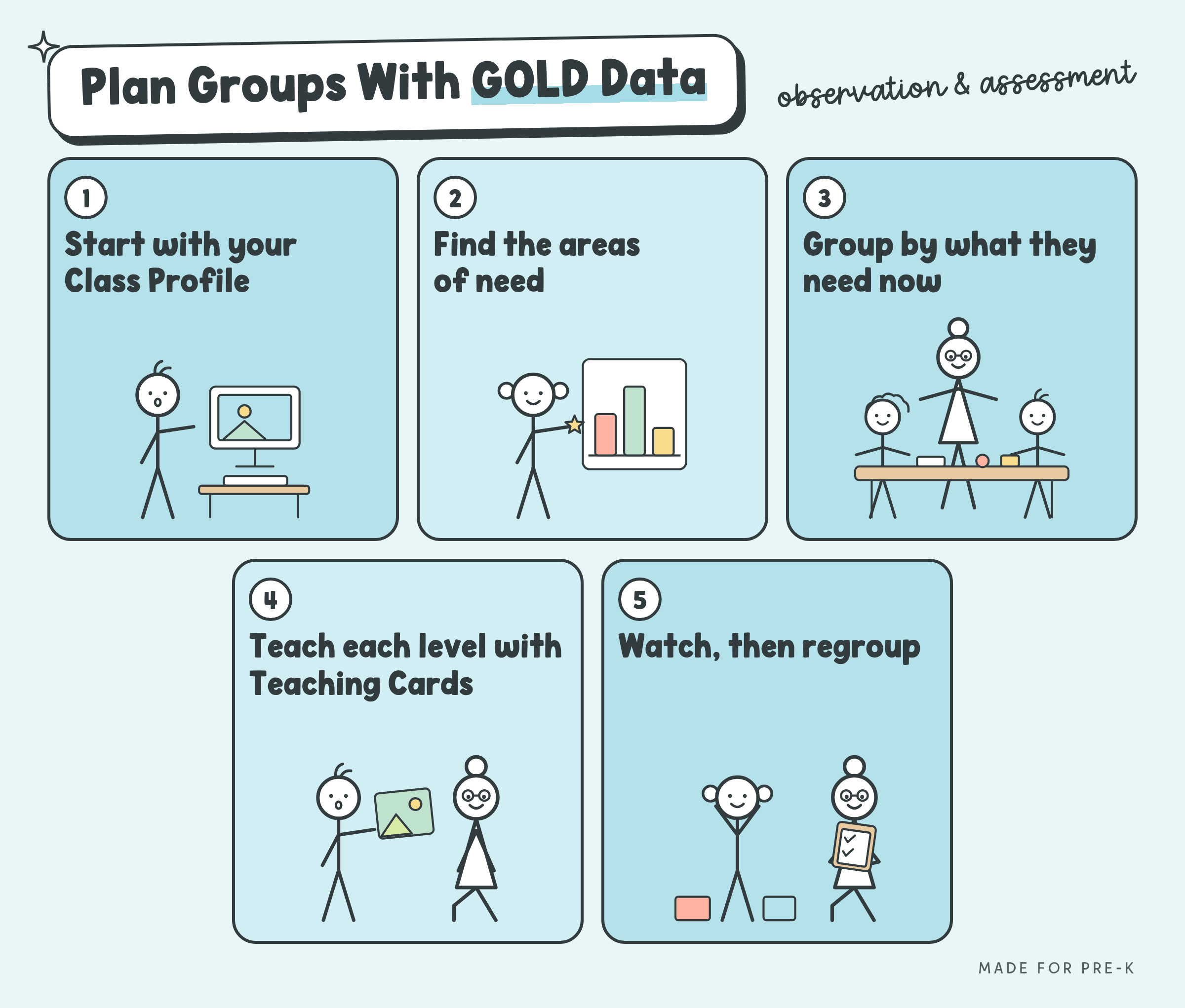
1. Start with your Class Profile report
Your Class Profile report gives you a snapshot of your students' levels by objective. Instead of thinking about 20 children one at a time, you can see the whole class on one objective at a glance.
Try this: Pull the Class Profile for one objective you're focusing on in this study, like counting or rhyming, before you plan next week's groups.
2. Find the areas of need
By looking at your GOLD data, including Snapshot reports and Class Profiles, you can see where students need more support. Look for the objective where a cluster of children is sitting at the same level, and for the children who are ready to be stretched.
Try this: Circle two objectives where several children need the same next step. Those are your small group targets for the next couple of weeks.
3. Group children by what they need right now
This is where data turns into action. Group children who need the same next step on that objective so you can teach right where they are. Groups aren't permanent labels. They're "who needs this skill this week."
Try this: Write each group on a sticky note by objective, not by "high, middle, low," so the groups stay flexible.
4. Use your Intentional Teaching Cards to teach each level
Intentional Teaching Cards have targeted strategies by level, so analyzing your data is key. Once you know where each child is, you can use the card's suggestions to differentiate: more support for one group, more challenge for another, using the same activity.
Try this: Before small groups, highlight the part of the card that matches each group's level so you're not reading it on the spot.
5. Watch, then regroup
Use your GOLD data to monitor progress and change your instruction as needed. Don't be afraid to switch up your groups if you see movement up or down in your students. That's why we meet with them daily: to notice these details through observation and play-based learning.
Try this: Pick one day every few weeks to check your groups against your newest observations and move any child who's ready.
Where does the data for my groups come from?
From the play and routines you're already watching. Notes, photos, work samples and quick checklists from small groups all feed back into GOLD, so every group you teach is also giving you the documentation for the next one. If you want ideas for capturing it without pulling children aside, here's my post on 9 types of documentation for Teaching Strategies GOLD.
When you use GOLD and your Intentional Teaching Cards together this way, small groups stop being "what's on the plan today" and become the most targeted part of your day.
Go deeper
If tracking 38 objectives feels like a lot to keep in your head, the Pre-K Assessment Data Binder gives you a checklist for each of the 38 Teaching Strategies objectives, with level examples, so you can see at a glance where every child is before you plan your groups. It's $11.
Start with one objective this week. Pull the Class Profile, form your groups, and teach to each level.
Frequently asked questions
How do I use GOLD data in small groups? Look at your Class Profile report for one objective, group children who need the same next step, and use the level-by-level strategies on your Intentional Teaching Cards to differentiate.
How often should I change my small groups? Whenever your observations show a child has moved up or down. Groups should be flexible, so check them every few weeks against your newest data.
What is a GOLD Class Profile report? A report in GOLD that shows your students' levels by objective in one place, so you can see patterns across the whole class.
Can I use GOLD if I don't use The Creative Curriculum? Yes. GOLD is designed to go with The Creative Curriculum, but it can be used with any curriculum.