
Ideas for the play‑based Pre‑K classroom
From one Pre-K teacher to another: research-grounded ideas you can bring into your classroom and adapt for your students.
Browse by classroom corner
No posts in this corner yet. More are on the way!
Free goodies for your classroom

Understanding the Challenges of Whole Group: A Research-Based Approach
When preschoolers resist whole group or carpet time, their behavior is usually communicating something: too much sensory input, a need for some control, an unmet emotional need or social dynamics with friends. The fix is rarely more rules. It's shorter, more fun gatherings plus strong relationships, real jobs, visual cues and real choices, so children want to be part of the group.
Here's a message one of our Facebook group members shared:
"I have a group of [students] that absolutely hate carpet time. They also despise read-alouds. Does anyone have any ideas on how to get them all to at least come to the carpet for a few minutes? I've tried finger plays, music and just pointing out pages in the book, to no avail. I've removed all items from the area, and now they are attacking each other. Please help before I lose my mind."
I completely understand this frustration, and so many of us have been there. When the usual tricks don't work, it's time to look deeper at the emotional and social needs behind the behavior.
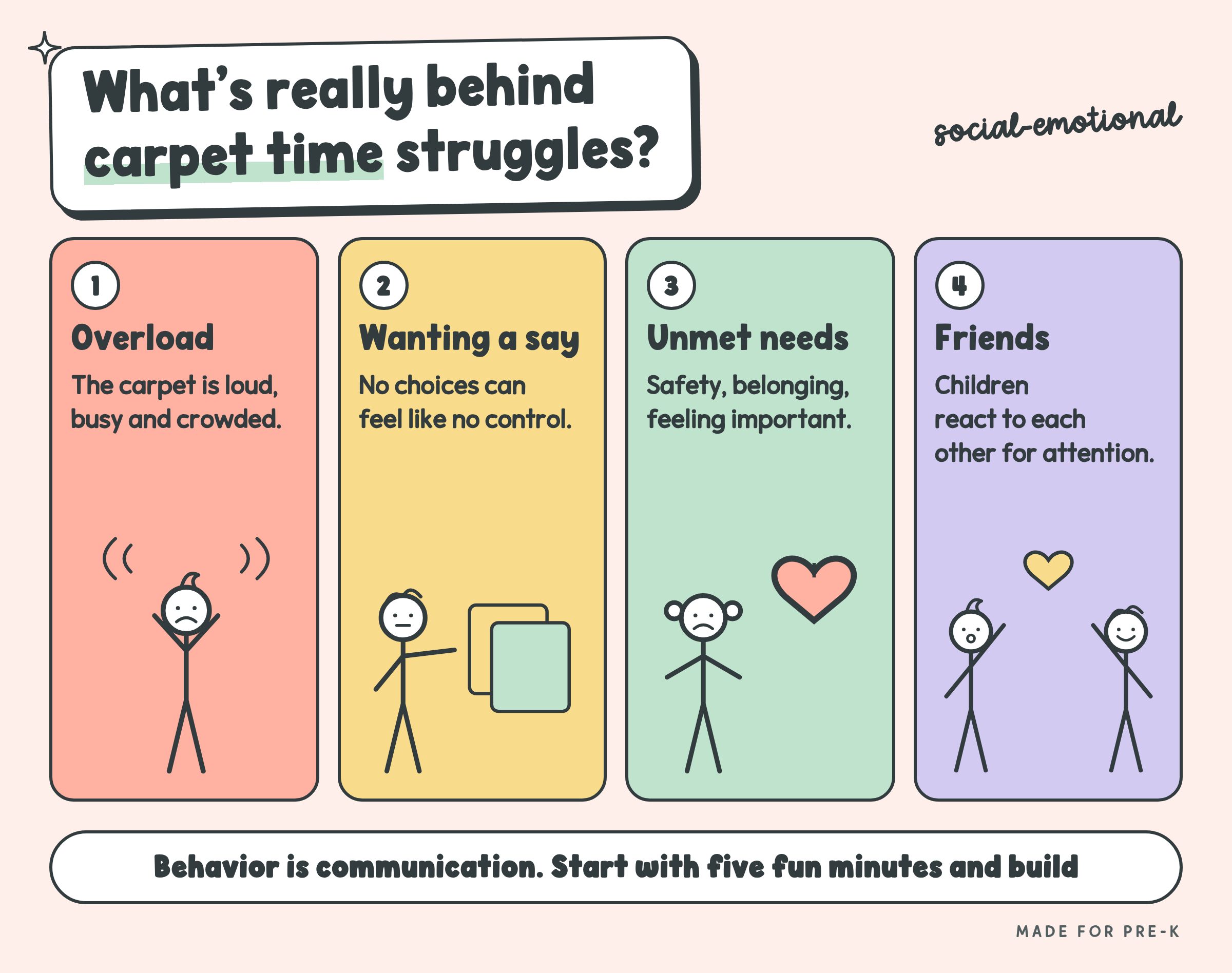
Why do some preschoolers struggle with carpet time?
Children's actions are rarely random. They're usually a form of communication or a reaction to something in the environment. Here are four common reasons children resist whole group:
Sensory overwhelm: The carpet is a busy space. All that noise, movement and closeness can make it hard for some children to focus.
A desire for autonomy: Children may resist when they feel they have no say in what's happening.
Emotional needs: Refusing to join can be a child's way of signaling unmet needs for safety, belonging or significance.
Social dynamics: Children react to each other and may be looking for attention or a place in the group.

How do I figure out what's behind the behavior?
Think of your classroom as a research lab. Every interaction gives you information about your students' emotional and social needs. When you watch closely (who struggles, when and with whom), you can adjust your teaching to meet those needs. Relationships are the foundation, especially in the first six weeks and beyond.
11 strategies that make whole group work
These strategies are teacher-tested and easy to start, even if this is your very first year teaching Pre-K. They focus on the behavior you want to see more of and on building a caring classroom community.
1. Make it fun, make it short
Short, interactive gatherings hold children's attention and leave less room for disruption. Fun activities also work as brain breaks that recharge everyone.
Try this: Start with a 5-minute puppet show that models sharing, then slowly extend your carpet time as students grow more comfortable.
2. Use a daily jobs chart
Roles like class helper give children responsibility and a real place in the community, which cuts down on disruptions.
Try this: Make a visual jobs chart with a job for every child and rotate roles so everyone contributes each day.
3. Notice and name what's going well
Specific, immediate acknowledgment helps children feel good and makes them more likely to repeat the behavior.
Try this: "I noticed you shared your playdough, and it made your friend smile. That was kind!"

4. Add visual cues
Pictures remind children of expectations without words and support self-regulation.
Try this: Take candid photos of your students sharing, cleaning up and listening. Post a photo of students walking in a line by the door and one of handwashing by the sink.
5. Get to know your students
Knowing each child's interests and needs helps you plan gatherings that feel safe and inviting.
Try this: Send home an All About Me form the first week. They love dinosaurs? Use it to build connections at the carpet.
6. Bring in family photos
Family photos are emotional anchors that give children comfort and a sense of belonging.
Try this: Put family photos on Velcro dots in cubbies so children can hold them when they miss home, and invite students to share them at circle time.

7. Call them leaders
Empowering language helps children see themselves as responsible members of the group.
Try this: Ask, "Leaders, are we ready to ___?" and keep talking together about what leaders do and say.
8. Hold class meetings
Regular meetings let children express themselves and learn about each other, which builds empathy and community.
Try this: Use your end-of-day Round Up to celebrate acts of kindness you noticed.
9. Set the rules together
Children are more likely to follow rules they helped create.
Try this: Make a Classroom Rules poster with your students' ideas, organized around Big Rules and Little Rules.
10. Offer real choices
Choices build decision-making and help children feel in control in a healthy way.
Try this: Let students choose between two books, two songs or two learning games you're comfortable with.
11. Make personalized books
Books about the children themselves build literacy and emotional connection at the same time.
Try this: Make simple books with photos of a child and their family, and read one at story time to celebrate that student.
Many of these ideas also build self-regulation. For more on that, read How to Teach Self-Regulation in Preschool: 6 Strategies.
Carpet time doesn't have to be a struggle
When we approach whole group like researchers, curious about our students' emotional and social needs, carpet time can change from chaotic to meaningful. Not every student will sit crisscross, and we shouldn't expect them to. Give yourself the flexibility to let each child be comfortable, safe and excited to learn, whatever that looks like for them.
Go deeper: Beyond Their Behavior
If behavior at the carpet feels like your biggest challenge right now, my workshop Beyond Their Behavior helps you understand what children's behavior is communicating and how to respond with co-regulation and connection.
Frequently asked questions
How long should circle time be in preschool? Start short, around 5 to 10 minutes at the beginning of the year, and build up as students are ready. Watch your students: wiggles and wandering are a sign it's time to wrap up or move.
What do I do with a child who won't come to the carpet? Look for the reason first. Offer a choice of spot, a job or a fidget, keep the gathering short and fun, and let them join from nearby while they warm up.
Do preschoolers have to sit crisscross at circle time? No. Some children listen best standing, kneeling or sitting on a cushion or chair. Comfort and engagement matter more than one posture.
Why are children hurting each other at the carpet? Crowding and too much input can quickly lead to bumping and conflict. Give each child a clear spot, more space and a shorter gathering, and teach and practice what to do with their bodies.