Ideas for the play‑based Pre‑K classroom
From one Pre-K teacher to another: research-grounded ideas you can bring into your classroom and adapt for your students.
Browse by classroom corner
No posts in this corner yet. More are on the way!
Free goodies for your classroom
Hands-On Math for Preschoolers: How to Build Number Sense Through Play
Young children build number sense by doing math, not memorizing it: counting real objects, combining and taking away, building patterns and exploring shapes and space with their hands. Hands-on, playful math with no worksheets and no screens gives preschoolers real understanding and real confidence, because the math is something they can hold.
Some links in this post are affiliate links, which means I earn a small commission at no extra cost to you. I only share materials I use with children.
As a former preschool teacher turned homeschool mom, I can tell you this is exactly how I would have wanted to teach math. Hands-on. Playful. No worksheets. No screens. Just real games that build real number sense, while intentionally scaffolding skills.
It's also why Lovevery's Math Skill Set, Part 1: Hands-On Math has become part of our homeschool. Whether you're a parent, a homeschooler or a teacher, if you spend your days playing and learning with young children, this one is worth a look.
What is number sense in preschool?
Number sense is a child's feel for numbers: knowing that "five" means five things, seeing that 3 and 2 make 5, noticing which group has more. It's the foundation for every math skill that comes later. Children build it through lots of hands-on experiences with real quantities, long before they write a single equation.
Why does hands-on math work for young children?
Preschoolers learn through their senses and their bodies. When they touch, build, experiment and play, an abstract idea like "add one more" becomes something they can see and feel. Hands-on math also gives children multiple pathways to the same concept, and that's how children actually learn. A child who has counted bears, built a pattern with blocks and walked the length of the rug understands numbers in a deeper way than one who only filled in a page.
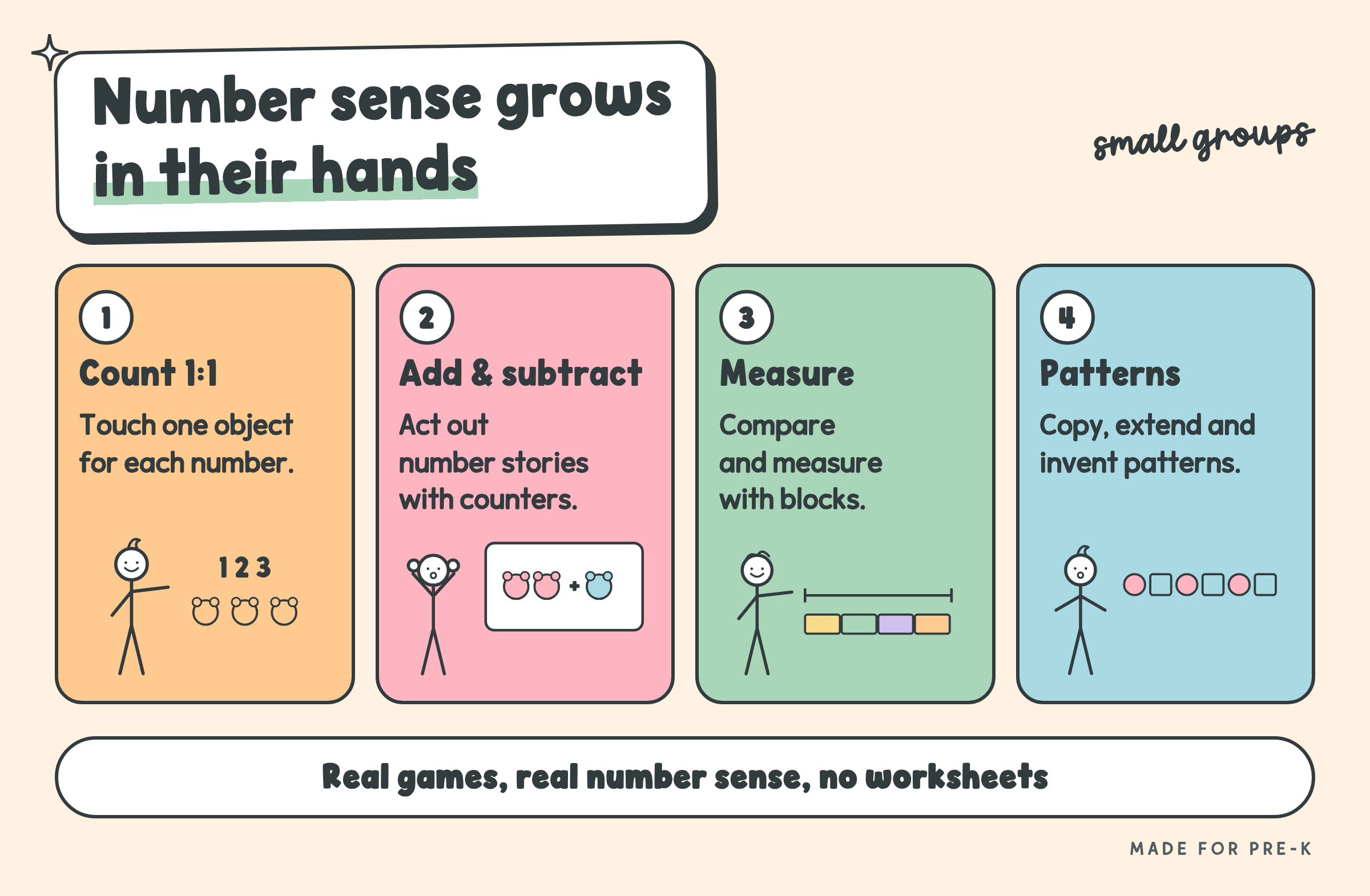
4 hands-on math skills to build in Pre-K
1. Count with one-to-one correspondence
One-to-one correspondence means touching or moving one object for each number you say. It's the difference between reciting numbers and truly counting.
Try this: At snack time, ask a student to give each friend one cracker and count as they go. Real reasons to count stick.
2. Add and subtract with real objects
Early addition and subtraction start with stories: two ducks swim over, one flies away. When children act out the story with objects, they start to build mental math strategies.
Try this: Use a "story mat" and small counters. "Three bears are at the picnic. Two more come. How many now?"
3. Explore spatial relationships and measuring
Words like over, under, next to, longer and shorter are math words. Building, comparing and measuring with everyday objects grows spatial thinking.
Try this: Measure the rug with blocks or shoes and compare. "Is the table longer or shorter than 10 blocks?"
4. Complete and build repeating patterns
Patterns are the start of algebraic thinking. Children who can copy, extend and create a pattern are learning to predict what comes next.
Try this: Start an AB pattern with clapping and stomping, then let students invent their own with blocks or beads.
What's in Lovevery's Hands-On Math set?
Hands-On Math is Part 1 of Lovevery's Math Skill Set, a hands-on program designed with math education experts. Lovevery describes it as covering Pre-K and kindergarten skills: counting with one-to-one correspondence, addition and subtraction with mental math strategies, spatial relationships and measuring, and repeating patterns. It's made of real games, activities and books, with no memorizing and no worksheets.
In Lovevery's 6-week study of Part 1 with 28 Lovevery families, 93% of children improved their math scores, as measured by the Preschool Early Numeracy Screener (PENS) and a study-specific assessment. I see the same thing with my own daughter: she went from Lovevery's baby play to reading chapter books on her own with their Reading Skill Set, and now she's exploring math the same way, by playing.
If you have a preschooler, a child heading into kindergarten or one already in kindergarten, it reinforces what's taught in school with a completely different approach. The program grows with your child: Part 2, Real-World Math, is now shipping and brings in time and money, and Part 3, Problem Solving with Math, is coming in 2027 with fractions and real-world problem solving.
How can teachers use it in the classroom?
The games fit beautifully into small groups. They're also a wonderful fit for MTSS: that precious intervention time can be fun and targeted with hands-on games that focus on one skill at a time.
Teachers, here's my tip: write a DonorsChoose grant for this set, and the Reading Skill Sets while you're at it. Hands-on materials like these are exactly what donors love to fund.
For more on making the most of that small group time, read Why Small Groups Matter in Pre-K (and What to Do in Them).
Go deeper: Hands-On Math
If you want the games, books and tools ready to go, check out Lovevery's Math Skill Set. And for free planning help, grab my free Pre-K lesson plan templates.
Frequently asked questions
What math should a 4-year-old know? Most 4-year-olds are working on counting objects with one-to-one correspondence, recognizing small groups without counting, comparing more and less, and noticing simple patterns. Every child develops at their own pace.
How can I teach math to preschoolers without worksheets? Use real objects and everyday moments: counting at snack, measuring with blocks, building patterns with toys and acting out number stories. Play gives children the hands-on experience worksheets can't.
What is one-to-one correspondence? It's matching one number word to one object while counting. A child who touches each bear as they say "1, 2, 3" is showing one-to-one correspondence.
Can teachers use the Lovevery Math Skill Set in a classroom? It's designed for families, but its games work well in small groups and intervention time. Many teachers fund materials like this through grants such as DonorsChoose.